American English File 2 Second Edition Pdf Free Download UPDATED
American English File 2 Second Edition Pdf Free Download

An 1888 advertisement for Webster'southward Unabridged Dictionary
Webster's Dictionary is any of the English linguistic communication dictionaries edited in the early 19th century by American lexicographer Noah Webster (1758–1843), as well as numerous related or unrelated dictionaries that have adopted the Webster'south name in honor. "Webster's" has since become a genericized trademark in the United states of america for English dictionaries, and is widely used in dictionary titles.[1]
Merriam-Webster is the corporate heir to Noah Webster's original works, which are in the public domain.
Noah Webster'south American Lexicon of the English language Linguistic communication [edit]
Noah Webster (1758–1843), the author of the readers and spelling books which dominated the American marketplace at the time, spent decades of research in compiling his dictionaries. His first lexicon, A Compendious Dictionary of the English, appeared in 1806. In it, he popularized features which would become a hallmark of American English language spelling (center rather than centre, laurels rather than honour, programme rather than programme, etc.) and included technical terms from the arts and sciences rather than confining his dictionary to literary words. Webster was a proponent of English spelling reform for reasons both philological and nationalistic. In A Companion to the American Revolution (2008), John Algeo notes: "it is often causeless that characteristically American spellings were invented by Noah Webster. He was very influential in popularizing sure spellings in America, but he did not originate them. Rather [...] he chose already existing options such every bit center, colour and check on such grounds as simplicity, illustration or etymology".[2] In William Shakespeare's showtime folios, for example, spellings such as eye and colour are the about common.[three] [4] He spent the next two decades working to expand his lexicon.
First edition 1828 [edit]

Title folio of the 1828 first edition of the American Dictionary of the English language featuring an engraving of Noah Webster

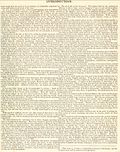
Extract from the Orthography section of the first edition, which popularized the American standard spellings of -er (vi); -or (7); dropped -e (8); -or (10); -se (11); doubling consonants with suffix (xv)
In 1828, when Noah Webster was lxx, his American Dictionary of the English Linguistic communication was published past South. Antipodal in 2 quarto volumes containing 70,000 entries,[5] every bit against the 58,000 of whatsoever previous lexicon. There were 2,500 copies printed, at $20 (adjusted for inflation: $539.77) for the two volumes. At showtime the set sold poorly. When he lowered the toll to $15 (adjusted for inflation: $404.82), its sales improved, and by 1836 that edition was wearied.[six] Not all copies were leap at the same time; the book likewise appeared in publisher'southward boards; other original bindings of a later on appointment are non unknown.[7]
Second edition 1841 [edit]
1841 printing [edit]
In 1841, 82-twelvemonth-old Noah Webster published a second edition of his lexicographical masterpiece with the assist of his son, William G. Webster. Its title folio does non claim the status of 2nd edition, merely noting that this new edition was the "outset edition in octavo" in contrast to the quarto format of the commencement edition of 1828. Once again in two volumes, the championship page proclaimed that the Dictionary contained "the whole vocabulary of the quarto, with corrections, improvements and several grand boosted words: to which is prefixed an introductory dissertation on the origin, history and connection of the languages of southwest asia and Europe, with an explanation of the principles on which languages are formed.[viii] B. 50. Hamlen of New Haven, Connecticut, prepared the 1841 printing of the 2d edition.[9]
1844 press [edit]
When Webster died, his heirs sold unbound sheets of his 1841 revision American Dictionary of the English Language to the business firm of J. Due south. & C. Adams of Amherst, Massachusetts. This house leap and published a modest number of copies in 1844 – the aforementioned edition that Emily Dickinson used as a tool for her poetic limerick.[10] [11] However, a $fifteen (adjusted for inflation: $512.78) cost tag on the book made information technology too expensive to sell easily, so the Amherst house decided to sell out. Merriam acquired rights from Adams, equally well as signing a contract with Webster'south heirs for sole rights.[12]
1845 printing [edit]
The third printing of the 2d edition was by George and Charles Merriam of Springfield, Massachusetts, in 1845.[13] This was the beginning Webster's Lexicon with a Merriam imprint.[7]
Touch [edit]
Lepore (2008) demonstrates Webster's innovative ideas nearly language and politics and shows why Webster's endeavors were at commencement so poorly received. Culturally conservative Federalists denounced the work as radical – too inclusive in its lexicon and fifty-fifty bordering on vulgar. Meanwhile, Webster's old foes, the Jeffersonian Republicans, attacked the man, labeling him mad for such an undertaking.[xiv]
Scholars have long seen Webster's 1844 dictionary to exist an important resource for reading poet Emily Dickinson'south life and work; she once commented that the "Lexicon" was her "only companion" for years. One biographer said, "The dictionary was no mere reference book to her; she read it every bit a priest his breviary – over and over, page past page, with utter absorption.";[15]
Austin (2005) explores the intersection of lexicographical and poetic practices in American literature, and attempts to map out a "lexical poetics" using Webster's dictionaries. He shows the ways in which American poetry has inherited Webster and drawn upon his lexicography to reinvent it. Austin explicates fundamental definitions from both the Compendious (1806) and American (1828) dictionaries and brings into its soapbox a range of concerns including the politics of American English language, the question of national identity and culture in the early moments of American independence, and the poetics of commendation and of definition.
Webster's dictionaries were a redefinition of Americanism within the context of an emergent and unstable American socio-political and cultural identity. Webster'southward identification of his projection as a "federal language" shows his competing impulses towards regularity and innovation in historical terms. Perhaps the contradictions of Webster's project represented a office of a larger dialectical play between freedom and club inside Revolutionary and post-Revolutionary political debates.[sixteen]
Other dictionaries with Webster'due south name [edit]
Noah Webster's assistant, and subsequently chief competitor, Joseph Emerson Worcester, and Webster'southward son-in-law Chauncey A. Goodrich, published an abridgment of Noah Webster'due south 1828 American Dictionary of the English Linguistic communication in 1829, with the same number of words and Webster'southward full definitions, just with truncated literary references and expanded etymology. Although it was more successful financially than the original 1828 edition and was reprinted many times, Noah Webster was critical of it.[9] Worcester and Goodrich's abridgment of Noah Webster's dictionary was published in 1841 by White and Sheffield, printed past Eastward. Sanderson in Elizabethtown, Due north.J. and again in 1844 by publishers Harper and Brothers of New York Metropolis, in 1844, with added words as an appendix.
New and Revised Edition 1847 [edit]
Upon Webster's death in 1843, the unsold books and all rights to the copyright and proper noun "Webster" were purchased by brothers George and Charles Merriam, who and so hired Webster's son-in-law Chauncey A. Goodrich, a professor at Yale College, to oversee revisions. Goodrich'southward New and Revised Edition appeared on September 24, 1847, and a Revised and Enlarged edition in 1848, which added a section of illustrations indexed to the text. His revisions remained close to Webster's work, but removed what later editors referred to as his "excrescences".
British impact [edit]
In 1850, Blackie and Son in Glasgow published the get-go general lexicon of English that made heavy use of pictorial illustrations integrated with the text, The Imperial Lexicon, English, Technological, and Scientific, Adapted to the Nowadays Country of Literature, Scientific discipline, and Fine art; On the Basis of Webster's English Dictionary. Editor John Ogilve used Webster's 1841 edition equally a base, adding many new, specialized, and British words, increasing the vocabulary from Webster 's 70,000 to more than 100,000.[17]
Unabridged edition 1864 [edit]
In response to Joseph Worcester's groundbreaking lexicon of 1860, A Dictionary of the English Linguistic communication, the G. & C. Merriam Visitor created a significantly revised edition, A Dictionary of the English Language.[18] It was edited by Yale University professor Noah Porter and published in 1864, containing 114,000 entries. Information technology was sometimes referred to equally the Webster–Mahn edition, considering it featured revisions by Dr. C. A. F. Mahn, who replaced unsupportable etymologies which were based on Webster'south attempt to adjust to Biblical interpretations of the history of language. Information technology was the first edition to largely overhaul Noah Webster's piece of work, and the first to be known as the Unabridged. Later printings included additional material: a "Supplement Of Additional Words And Definitions" containing more than 4,600 new words and definitions in 1879, A Pronouncing Biographical Dictionary containing more than 9,700 names of noteworthy persons in 1879, and a Pronouncing Gazetteer in 1884. The 1883 printing of the book contained 1,928 pages and was 8½ in (22 cm) wide past 11½ in (29 cm) tall by 4¼ in (11 cm) thick. The 1888 printing (revision?) is similarly sized, with the terminal printed page number "1935" which has on its back further content (hence, 1936th page), and closes with "Whole number of pages 2012". This lexicon carries the 1864 Preface by Noah Porter with postscripts of 1879 and 1884.
James A.H. Murray, the editor of the Oxford English Lexicon (1879–1928) says Webster's entire edition of 1864 "acquired an international fame. Information technology was held to be superior to every other dictionary and taken every bit the leading potency on the meaning of words, not only in America and England, simply besides throughout the Far Eastward."[19]
Webster'south International Lexicon (1890 and 1900) [edit]
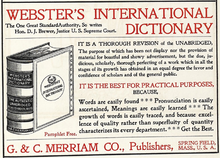
1896 advertisement for the 1890 International edition
Porter also edited the succeeding edition, Webster'southward International Dictionary of the English language (1890), which was an expansion of the American Dictionary. It independent about 175,000 entries. In 1900, Webster's International was republished with a supplement that added 25,000 entries to it.
In 1898 the Collegiate Lexicon as well was introduced (see beneath).
Webster's New International Dictionary 1909 [edit]

The Merriam Company issued a complete revision in 1909, Webster's New International Dictionary, edited by William Torrey Harris and F. Sturges Allen. Vastly expanded, it covered more than 400,000 entries, and double the number of illustrations. A new format feature, the divided folio, was designed to salvage space past including a section of words beneath the line at the bottom of each page: six columns of very fine print, devoted to such items every bit rarely used, obsolete, and foreign words, abbreviations, and variant spellings. Notable improvement was made in the treatment and number of discriminated synonyms, comparisons of subtle shades of meaning. Also added was a xx-page nautical chart comparing the Webster's pronunciations with those offered by half dozen other major dictionaries. This edition was reprinted in 1913. Being in the public domain and having been scanned and OCRd, this edition has had substantial influence on Wiktionary.
Webster's New International Dictionary (2nd edition, 1934) [edit]
In 1934, the New International Dictionary was revised and expanded for a 2nd edition, which is popularly known as Webster's Second or W2, although it was not published nether that title. It was edited by William Allan Neilson and Thomas A. Knott. Information technology contained 3350 pages and sold for $39.fifty (adapted for inflation: $755.77). Some versions added a 400-page supplement chosen A Reference History of the World, which provided chronologies "from earliest times to the nowadays". The editors claimed more 600,000 entries, more than whatever other dictionary at that fourth dimension, but that number included many proper names and newly added lists of undefined "combination words". Multiple definitions of words are listed in chronological club, with the oldest, and often obsolete, usages listed starting time. For example, the beginning definition of starve includes dying of exposure to the elements also as from lack of food.
The numerous moving-picture show plates added to the volume'due south entreatment and usefulness, peculiarly when pertaining to things found in nature. Conversely, the plate showing the coins of the world'south important nations quickly proved to be imperceptible. Numerous gilt coins from various important countries were included, including American eagles, at a time when it had recently become illegal for Americans to own them, and when near other countries had withdrawn gold from active circulation as well.
Early printings of this dictionary contained the erroneous ghost word dord.
Because of its style and give-and-take coverage, Webster's 2nd is all the same a popular lexicon. For example, in the case of Miller Brewing Co. 5. Yard. Heileman Brewing Co., Inc., 561 F.2d 75 (seventh Cir. 1977)[twenty] – a trademark dispute in which the terms "lite" and "light" were held to be generic for light beer and therefore bachelor for utilize by anyone – the U.S. Court of Appeals for the Seventh Circuit, after considering a definition from Webster's Third New International Dictionary, wrote that "[T]he comparable definition in the previous, and for many the classic, edition of the same dictionary is as follows:..."
Webster'southward Tertiary New International Dictionary (1961) [edit]
Later most a decade of preparation, G. & C. Merriam issued the entirely new Webster'due south Third New International Dictionary of the English Language, Entire (commonly known as Webster'due south Third, or W3) in September 1961.
Although it was an unprecedented masterwork of scholarship, it was met with considerable criticism for its descriptive (rather than prescriptive) approach.[21] The dictionary'south treatment of "ain't" was subject field to detail scorn, since it seemed to overrule the near-unanimous denunciation of that discussion past English teachers.
Revisions and updates [edit]
Since the 1961 publication of the Third, Merriam-Webster has reprinted the primary text of the dictionary with only minor corrections. To add new words, they created an Addenda Department in 1966, included in the front matter, which was expanded in 1971, 1976, 1981, 1986, 1993, and 2002. However, the rate of additions was much slower than it had been throughout the previous hundred years. Following the purchase of Merriam-Webster by Encyclopædia Britannica, Inc. in 1964, a iii-volume version was issued for many years as a supplement to the encyclopedia. At the finish of book three, this edition included the Britannica Earth Language Lexicon, 474 pages of translations between English language and French, German, Italian, Spanish, Swedish, and Yiddish. A CD-ROM version of the complete text, with thousands of additional new words and definitions from the "addenda", was published past Merriam-Webster in 2000, and is oft packaged with the print edition. The third edition was published in 2000 on Merriam-Webster's website every bit a subscription service.
Planning for a Fourth edition of the Unabridged began with a 1988 memo from Merriam-Webster president William Llewellyn, but was repeatedly deferred in favor of updates to the more lucrative Collegiate. Work on a total revision finally began in 2009. In January 2013 the Third New International website service was rebranded as the Unabridged with the first "Release" of 4,800 new and revised entries added to the site. There were 2 further "Releases" in 2014. The revised website is not branded equally the "4th edition" and it is unlikely that a print version will always be produced, because demand is declining and its increased size would make it unwieldy and expensive.[22] [23] [24]
Merriam-Webster's Collegiate Dictionary [edit]

Merriam-Webster'due south eleventh edition of the Collegiate Lexicon
Merriam-Webster introduced its Collegiate Dictionary in 1898 and the series is now in its eleventh edition. Following the publication of Webster's International in 1890, two Collegiate editions were issued as abridgments of each of their Unabridged editions.
With the ninth edition (Webster'south Ninth New Collegiate Dictionary (WNNCD), published in 1983), the Collegiate adopted changes which distinguish it as a split entity rather than but an abridgment of the "Third New International." Some proper names were returned to the discussion list, including names of Knights of the Round Table. The well-nigh notable change was the inclusion of the date of the kickoff known commendation of each give-and-take, to document its entry into the English language. The eleventh edition (published in 2003) includes more 225,000 definitions, and more 165,000 entries.[25] A CD-ROM of the text is sometimes included.
This lexicon is preferred as a source "for general matters of spelling" by The Chicago Manual of Fashion, which is followed by many book publishers and magazines in the Us. The Chicago Manual states that it "normally opts for" the start spelling listed.[26]
In add-on to its Collegiate editions Chiliad. & C. Merriam Co. as well produced abridged editions for students (Primary School, Elementary School, Secondary School, High School, Common School, Academic) too as for general public (Condensed, Practical, Handy). The first edition of the abridged Master Schoolhouse dictionary was prepared by Noah Webster in 1833 and later revised by William Chiliad. Webster and William A. Wheeler.
Editions [edit]
Below is a listing of years of publication of the Collegiate dictionaries.
- 1st: 1898
- 2nd: 1910
- 3rd: 1916
- quaternary: 1931
- fifth: 1936
- 6th: 1949
- seventh: 1963
- eighth: 1973
- 9th: 1983
- 10th: 1993
- 11th: 2003
The name Webster used by others [edit]
Since the late 19th century, dictionaries bearing the name Webster'south accept been published by companies other than Merriam-Webster. Some of these were unauthorized reprints of Noah Webster'south work; some were revisions of his piece of work. One such revision was Webster's Purple Dictionary, based on John Ogilvie'southward The Imperial Dictionary of the English language, itself an expansion of Noah Webster's American Dictionary.
Following legal activeness past Merriam, successive US courts ruled by 1908 that Webster's entered the public domain when the Entire did, in 1889.[27] In 1917, a Usa courtroom ruled that Webster's entered the public domain in 1834 when Noah Webster's 1806 lexicon's copyright lapsed. Thus, Webster's became a genericized trademark and others were complimentary to use the name on their own works.
Since then, apply of the proper noun Webster has been rampant. Merriam-Webster goes to great pains to remind lexicon buyers that it alone is the heir to Noah Webster.[28] [29] Although Merriam-Webster revisers notice solid footing in Noah Webster's concept of the English language as an ever-irresolute tapestry, the consequence is more complicated than that. Throughout the 20th century, some non-Merriam editions, such equally Webster's New Universal, were closer to Webster'southward work than contemporary Merriam-Webster editions.[ citation needed ] Further revisions by Merriam-Webster came to have footling in common with their original source,[ citation needed ] while the Universal, for example, was minimally revised and remained largely out of date.
So many dictionaries of varied size and quality have been chosen Webster'south that the proper name no longer has whatever specific brand meaning.[ citation needed ] Despite this, many people notwithstanding recognize and trust the name. Thus, Webster's continues every bit a powerful and lucrative marketing tool.[ citation needed ] In contempo years,[ when? ] even established dictionaries with no directly link to Noah Webster any have adopted his proper name, adding to the defoliation. Random House dictionaries are now called Random Firm Webster'due south, and Microsoft'south Encarta World English language Dictionary is now Encarta Webster'due south Dictionary. The lexicon at present chosen Webster'southward New Universal no longer fifty-fifty uses the text of the original Webster's New Universal dictionary, but rather is a newly commissioned version of the Random Business firm Dictionary.
The Webster's Online Dictionary: The Rosetta Edition is not linked to Merriam-Webster Online. It is a multilingual online dictionary created in 1999 past Philip One thousand. Parker.[thirty] This site compiles different online dictionaries and encyclopedia including the Webster'south Revised Unabridged Dictionary (1913), Wiktionary and Wikipedia.[31]
Competition [edit]
Noah Webster'due south main competitor was a man named Joseph Emerson Worcester, whose 1830 Comprehensive Pronouncing and Explanatory Lexicon of the English language brought accusations of plagiarism from Webster. The rivalry was carried on by Merriam after Webster's death, in what is often referred to as the "Dictionary Wars". After Worcester's death in 1865, revision of his Dictionary of the English language Language was presently discontinued and it eventually went out of impress.
The American edition of Charles Annandale's iv volume revision of The Imperial Dictionary of the English Language, published in 1883 by the Century Visitor, was more than comprehensive than the Entire. The Century Lexicon, an expansion of the Majestic showtime published from 1889 to 1891, covered a larger vocabulary until the publication of Webster's Second in 1934, later the Century had ceased publication.
In 1894 came Funk & Wagnalls Standard Dictionary, an bonny one book analogue to Webster'south International. The expanded New Standard of 1913 was a worthy challenge to the New International, and remained a major competitor for many years. Yet, Funk & Wagnalls never revised the work, reprinting information technology nearly unchanged for more than 50 years, while Merriam published two major revisions.
The Oxford English Lexicon (OED), which published its complete outset edition in 1933, challenged Merriam in scholarship, though not in the marketplace due to its much larger size. The New International editions continued to offer words and features non covered by the OED, and vice versa. In the 1970s, the OED began publishing Supplements to its dictionary and in 1989 integrated the new words in the supplements with the older definitions and etymologies in its Second Edition.
Betwixt the 1930s and the 1950s, several higher dictionaries, notably the American Higher Dictionary and (non-Merriam) Webster's New World Dictionary, entered the market alongside the Collegiate. Among larger dictionaries during this period was (not-Merriam) Webster'southward Universal Dictionary (also published as Webster's Twentieth Century Lexicon) which traced its roots to Noah Webster and called itself "unabridged", only had less than half the vocabulary and paled in scholarship against the Merriam editions.
After the commercial success of Webster'due south Third New International in the 1960s,[32] Random House responded by adapting its college dictionary by adding more illustrations and big numbers of proper names, increasing its impress size and page thickness, and giving it a heavy cover. In 1966, information technology was published every bit a new "unabridged" dictionary. Information technology was expanded in 1987, just it all the same covered no more than than half the actual vocabulary of Webster'due south Third.
The American Heritage Publishing Co., highly critical of Webster's Third, failed in an attempt to purchase out Merriam-Webster and determined to create its own dictionary, The American Heritage Dictionary of the English Language. In 1969, it issued a college-sized dictionary. At present in its 5th edition, it is only slightly greater in vocabulary than the Collegiate, but it appears much larger and has the appeal of many pictures and other features, such as a usage panel of linguistic communication professionals which is polled for the acceptability of certain give-and-take usage, and a word for some entries of subtle differences amidst words with similar meaning. Other medium-sized dictionaries accept since entered the market, including the New Oxford American and the Encarta Webster's, while Merriam-Webster has not attempted to compete by issuing a similar edition.
References [edit]
- ^ "Merriam-Webster FAQ". Retrieved Jan 24, 2008.
- ^ Algeo, John. "The Effects of the Revolution on Language", in A Companion to the American Revolution. John Wiley & Sons, 2008. p. 599
- ^ -or. Online Etymology Dictionary.
- ^ Venezky, Richard. The American Way of Spelling: The Structure and Origins of American English Orthography. Guilford Printing, 1999. p. 26
- ^ "Catalog entry". Library of Congress.
- ^ Skeel, Emily. A Bibliography of the Writings of Noah Webster (1958), p. 234.
- ^ a b "Rulon-Miller Books :: Recent Acquisitions".
- ^ Noah Webster, An American Dictionary of the English Language, second edition (New Haven, Connecticut: the author, 1841).
- ^ a b Morton, H. C. The Story of Webster's Tertiary: Philip Gove's Controversial Dictionary and Its Critics. Cambridge Academy Printing, 1995 ISBN 0-521-55869-seven, ISBN 978-0-521-55869-3
- ^ "Emily Dickinson Lexicon".
- ^ Noah Webster, An American Dictionary of the English Language, second edition (Amherst, Massachusetts: J. S. & C. Adams, 1844).
- ^ "1000&C Merriam: Where the words of Noah Webster lived and thrived" Wayne Phaneuf, The Republican
- ^ Noah Webster, An American Dictionary of the English Linguistic communication, 2nd edition (Springfield, Massachusetts: George & Charles Merriam, 1845).
- ^ Jill Lepore, "Introduction" in Arthur Schulman, Websterisms: A Collection of Words and Definitions Prepare Forth past the Founding Father of American English (Free Press, 2008).
- ^ Deppman, Jed (2002). "'I Could Not Have Defined the Change': Rereading Dickinson's Definition Poetry". Emily Dickinson Journal. 11 (1): 49–80. doi:10.1353/edj.2002.0005. ; Martha Dickinson Bianchi, The life and messages of Emily Dickinson (1924) p. fourscore for quote
- ^ Nathan Due west. Austin, "Lost in the Maze of Words: Reading and Re-reading Noah Webster'south Dictionaries," Dissertation Abstracts International, 2005, Vol. 65 Issue 12, p. 4561
- ^ Michael Hancher, "Gazing at the Purple Dictionary," Volume History, Volume 1, 1998, pp. 156–181 doi:ten.1353/bh.1998.0006
- ^ Landau, Sidney (2001). Dictionaries: The Fine art and Craft of Lexicography (second ed.). Cambridge University Printing. ISBN0 521 78512 Ten.
- ^ M. Chiliad. Elisabeth Murray, Caught in the Web of Words: James Murray and the Oxford English language Dictionary (1977), p. 133
- ^ "United States Court of Appeals, Seventh Excursion". Retrieved September xiii, 2010.
- ^ Herbert Charles Morton, The Story of Webster'south Third: Philip Gove'southward Controversial Lexicon and its Critics (1995) p. 123
- ^ Skinner, David (July–August 2009). "Ain't That the Truth: Webster's Tertiary: The Most Controversial Dictionary in the English language Language". Humanities. National Endowment for the Humanities. 30 (iv). Retrieved May 1, 2021.
- ^ Fatsis, Stefan (January 12, 2015). "The Definition of a Lexicon". Slate.com. Retrieved Apr 25, 2015.
- ^ Metcalf, Allan (June 12, 2013). "Entire Online". The Chronicle of Higher Pedagogy . Retrieved January 19, 2018.
- ^ "Dictionary Adds 150 Entries to Updated Edition". NBC News. Reuters. May 19, 2014. Retrieved November 25, 2021.
- ^ The Chicago Manual of Style, 15th edition, New York and London: University of Chicago Press, 2003, Chapter 7: "Spelling, Distinctive Treatment of Words, and Compounds", Section 7.1 "Introduction", p. 278
- ^ K. & C. Merriam Co. v. Ogilvie, 159 Fed. 638 (1908)
- ^ "Merriam-Webster FAQ".
- ^ "Merriam-Webster Continues Noah Webster's Legacy". world wide web.merriam-webster.com . Retrieved May 12, 2018.
- ^ "Fascinating facts nearly Philip Parker inventor of the Due west-O-D Project in 1999". Ideafinder.com. Vaunt Design Group. Nov 1, 2006. Archived from the original on September 7, 2007. Retrieved August 31, 2010.
- ^ "Webster's Online Dictionary – Definition: dictionary". websters-online-dictionary.org. ICON Grouping International, Inc. Archived from the original on February 22, 2004. Retrieved August 29, 2010.
- ^ Reid, T. R. (Nov 8, 1987). "Dauntless New Words a Dictionary for Today". The Washington Post . Retrieved July 15, 2017.
Further reading [edit]
- Gove, Philip B. (1961). Webster's 3rd New International Lexicon. Preface. G. & C. Merriam.
- Landau, Sidney I. (1989) Dictionaries: The Art and Craft of Lexicography. Cambridge Academy Printing. Second Edition, 2001.
- Leavitt, Robert Keith (1947). Noah'south Ark New England Yankees and the Endless Quest: a Short History of the Original Webster Dictionaries, With Particular Reference to Their Commencement Hundred Years. Springfield: G. & C. Merriam.
- Lepore, Jill (Nov 6, 2006). "Noah'southward Mark: Webster and the original dictionary wars". The New Yorker: 78–87.
- Morton, Herbert C. (1994). The Story of Webster's Third: Philip Gove's Controversial Dictionary and Its Critics. Cambridge and New York: Cambridge University Press. ISBN978-0-521-46146-vii.
- Neilson, William A.; et al. (1934). Webster'south New International Dictionary. Preface and Introduction (Second ed.). G. & C. Merriam.
- Rollins, Richard Grand. (1980). The Long Journey of Noah Webster . Philadelphia: The University of Pennsylvania Press. ISBN978-0-8122-7778-4.
- Skinner, David (2012). The Story of Ain't: America, Its Language, and the Most Controversial Dictionary Ever Published. New York: HarperCollins. ISBN978-0-0620-2746-7.
- Sledd, James; Ebbit, Wilma R., eds. (1962). Dictionaries and That Dictionary. Chicago: Scott Foresman.
External links [edit]
1828 edition [edit]
The 1828 edition of the American Lexicon of the English language (2 volumes; New York: Due south. Converse) tin be searched online at:
- 1828.mshaffer.com
- webstersdictionary1828.com
DjVu and PDF versions tin exist viewed at the Internet Archive:
- Book ane (includes words starting with A to I)
- Book 2 (includes words starting with J to Z)
Obviously-text versions are also available from the Internet Archive (with some errors, due to automated optical character recognition).
1841 (1844) edition [edit]
- 1841 edition (published 1844) on the Emily Dickinson site. The last edition of the American Dictionary of the English language Language that Noah Webster made before his death.
- 1828.mshaffer.com
1847 edition [edit]
An American Lexicon of the English language, edited past Chauncey A. Goodrich.
- 1847 print
- 1857 impress
1859 edition [edit]
An American Lexicon of the English language Language, edited by Chauncey A. Goodrich, first pictorial edition.
- 1861 impress
- 1862 impress
1864 edition [edit]
An American Dictionary of the English language Language, edited by Noah Porter and C. A. F. Mahn
- 1865 print
- 1886 impress
1890 edition [edit]
Webster'south International Dictionary, edited past Noah Porter and W. T. Harris, 1890 edition plus 1900 supplement
- 1907 print on HathiTrust
- 1898 print on the Internet Annal of the Australian edition with an Australian supplement
1909 edition [edit]
Webster's New International Dictionary, 1st edition
- 1930 revision on HathiTrust, on the Internet Annal
1913 edition [edit]
The Webster's Revised Entire Dictionary (editor Noah Porter, Springfield, MA: C. & Yard. Merriam Co., 1913), from which copyright has lapsed and is at present in the public domain, has been digitized in 1996 by MICRA, Inc.[1][2] and is now available at various costless online resources, including:
- Projection Gutenberg:
- Original raw version 0.fifty, texts No. 660 to No. 670, in E-text/Due east-Book format
- #673, in i file, in E-text/E-Book format
- #29765, in one file, plainly text version
- OPTED (Online Evidently Text English Dictionary), apparently text, divided by messages
- Electronic version in EPWING/JIS X 4081 format
- Collaborative International Lexicon of English, GCIDE, and DICT
- dict.org, DICT Development Group
- HyperDictionary.com
- www.websters1913.com
School dictionaries [edit]
- Lexicon for Principal Schools (1833), past Noah Webster, on Internet Archive
- Primary School Dictionary (1867) on the Internet Annal, 1871 print, 1874 impress
- Webster'southward Primary School Lexicon (1892) on the Internet Archive
- Webster's Unproblematic-School Dictionary (1914) on the Internet Archive
- Webster's Secondary-Schoolhouse Dictionary (1913) on HathiTrust, on the Net Archive
- Common-Schoolhouse Dictionary (1867) on HathiTrust, on Internet Archive
- Webster'due south Common School Dictionary (1892) on HathiTrust
- High-Schoolhouse Lexicon (1868) on the Net Archive
- Webster'south High School Dictionary (1892) on HathiTrust, on the Cyberspace Archive, on the Internet Archive
- Webster's Bookish Dictionary (1895) on the Net Archive
Collegiate Dictionary [edit]
- 1st edition (1898), on HathiTrust, on the Internet Archive, 1909 print on HathiTrust
- 2nd edition (1910), 1914 print on HathiTrust
- tertiary edition (1916)
- 1916 print on HathiTrust, on the Internet Annal
- 1917 print on HathiTrust
- 1919 print on HathiTrust, on the Internet Archive
- 11th Edition (2003), the most contempo edition of the Merriam-Webster'southward Collegiate Lexicon bachelor online on the company's website
DOWNLOAD HERE
Posted by: archibaldwhiso1993.blogspot.com

